What the OFDA!

The OFDA laser scanning technology has revolutionized fiber testing all over the world and especially in fiber producing animal industries. An Australian technology developed out of Perth, Western Australia, the OFDA system offers reliable, efficient and consistency in reading fibers. It is the technology of the future and is widely used by wool and alpaca fiber producers, breeders and processors around the world.

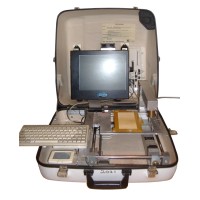
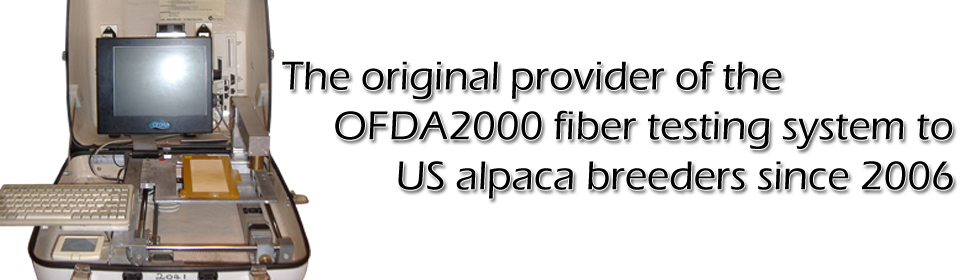
For alpaca breeders there are two primary OFDA testing services available in the USA. One is the laboratory based OFDA 100 and the other, the portable OFDA 2000. While the technology is the same for both systems, the application, and results, are different.

The OFDA 100

The OFDA 100 was developed primarily as a technology to more accurately describe what is in a pressed bale of wool. Traditionally, wool is classed by hand and eye in the shearing shed and placed in bins of like description fleeces. These descriptions are universal in their wording and intent and include such descriptors as length, micron, degree of vegetable matter, etc.

When hand-classed fleeces are lotted into bales there can be some inconsistencies through the bale no matter how consistent the classing is on the table. The OFDA 100 was developed to test the consistency of what was in the bale through a sampling technique called coring which, in essence, is a number of rods pierced through the bale from different directions thus collecting samples of a range of fleeces and, in some cases, within any particular fleece, which are then chopped into 2mm lengths and analyzed by laser scan.

The results give an accurate description of the micron, standard deviation and other relevant measurements valuable to the efficiency and productivity (therefore profitability) of that bale for the buyer and processor.

The protocol relies upon a random sampling of sites along the entire length of the staple as the core passes through the fleeces.

The OFDA 100 test offered in the USA is the butt sample test, a variation of the above protocol.

In the butt sample test, a 2mm sample is cut from a mark approximately 1cm (0.5 inch) from the cut end (nearest the skin) of the sample as it is submitted to the laboratory and it is this sample that is measured. 2mm represents about 7 days fiber growth for an average alpaca.

Butt sample testing in the USA also uses a quality assurance standard in the preparation of the sample prior to testing. This standard ensures that every sample is tested in the same environment after washing, drying and stabilizing prior to cutting and reading. The standard enables results to be compared not only between laboratories but also between years as it narrows the possibilities of inconsistencies between results.

Applying a quality assurance standard to a test does not validate the test itself nor the outcome, it does validate the consistency of testing preparations.

The OFDA 100 also allows determination of medullated fibers in white and some light fleeces.

The OFDA 2000

The OFDA 2000 uses the same technology as the OFDA 100 but applies it in a different fashion and gives a different result, making the two test results incomparable. The OFDA 2000 requires a sample to be spread across an inert plastic grid in a way that exposes as many fibers as possible to scanning as the camera moves across the sample tray as the tray moves to expose the full length of fibers to the scan.

Within the field of the laser, as it moves across and down the sampler tray, fibers that are crossed or not allowing a minimum field of measurement, are excluded from the count, only fibers free from others are measured.

As the scan progresses, the data is compiled, analysed and plotted and an average fiber profile is developed created by the measurements recorded with each passing scan of the sample tray.

The results are therefore representative of the total length of the fiber/staple, which is what buyers purchase and is what classers class.

The technology measures the temperature and humidity at the time of testing and also makes an allowance for grease content as it develops the results so all results are comparable no matter what environmental conditions are prevailing at the time of testing.

The Pros and Cons

The nature of each testing system denies users the opportunity to compare differently tested samples consistently.

Research has shown that there are times when the two tests on the same, or as close to same as one can get, sample give the same result but these are few in number when compared to those that are not similar.

So what are the differences?

Firstly, and importantly, the butt sample test measures data from up to one week in the life of that sample whereas the 2000 tests the entire length of the fiber; in other words, one tests a short time span and length and the other the complete length and time that fiber has taken to grow.

Buyers buy the entire length of the fiber, not just a week and no buyer bases their buy on anything other than a sampling of the entire length. It should be noted that core sampling takes samples from different positions along the length of any fiber as the sampling rod passes through the bale and/or fleece sample and so those results are representative of the total length of fibers in that bale.

Secondly, fiber micron varies from season to season and from environment to environment and this is reflected along the length of the fiber—from as little as 1 micron to as much as 7 micron depending on the season, the nutrition on offer, pregnancy, lactation, stress, etc. A butt sample result does not reflect any seasonal, nutritional or health induced micron change, all it does is reveal what the micron was at that particular stage of the fiber’s growth.

Thirdly, butt sample micron results can be influenced and manipulated through management practices either intentionally or unintentionally, simply by knowing where the sample will be taken from and adjusting nutrition to create an artificial micron low at that time.

Fourthly, because we know that micron changes through a growing year, using a butt sample test result as the definitive statement as to the micron of any particular fleece can mislead growers and breeders who assume what they are seeing and feeling is that defined micron when, in reality, it may be nothing like what they are feeling and seeing.

This is a very important point for alpaca enthusiasts to consider and ponder.

The OFDA 2000 test result reflects the average of the entire length and the average fiber profile illustrates where the variations occur along the length.

The average fiber profile clearly demonstrates the effects of nutrition, environment and management on individual animals within a herd and allows breeders to identify, more accurately, those lines of breeding females that do better in that particular environment—a very useful selection and culling tool as the quality of the herd becomes better and better.

Average fiber profile also identifies dams that may have better milking performance than others as this is graphically represented on the profile yet may not have been evident in the day-to-day observation of the cria and dam.

Stress can be identified as can feed changes and changed management conditions and practices which, when combined with an accurate farm diary, can assist in proactive management changes or alertness with specific alpacas or across the herd depending upon the information revealed.

The differences between the testing protocols are what individual breeders and growers will make of them and it may be useful in considering the following when deciding between the two technologies:

Declaration:
The author is an independent alpaca industry consultant who operates an OFDA 2000 fiber testing system as a part of his consultancy practice. Ian can be contacted at or by phone at (805) 772 1774.
© Ian Watt 2007


For further information, contact Ian Watt at
Alpaca Consulting Services USA
1540 San Bernardo Creek Road
Morro Bay California 93442
+ 1 805 772 1774

Top of Page